The Cellf
By Zulaykha W. Ahmadzada
September 26, 2026
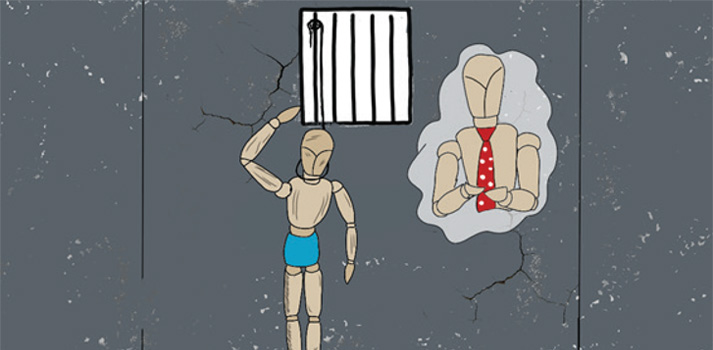
Artwork: Dima Daly
Men walked out of Sednaya's gates in December 2024 like limbs after deep sleep: clumsy, dazed, relearning their own weight. It was, rightly, called justice. Yet a door opening is not an apology for what happened behind it.
Release answered for custody, but not for what custody was.
States have long built legal categories to hold individuals indefinitely, never charged, never released. The result is the cellf, an identity a system intentionally made unrecognizable. Syria's detention system ran on the same logic, at a scale that made Guantánamo look like a rehearsal. Decades of emergency law allowed a person to vanish into state custody with no explanation. Families call the missing al-mafqudin, a category built so precisely no one has had to answer for where they went.
Eighteen months after Sednaya's gates opened, Syria created the National Commission for Transitional Justice meant to answer for what happened inside the prison. Survivors of detention and torture now help write its policy, not just testify to it. But a deeper problem sits underneath, one no commission alone can fix: Syrian law itself has no legal definition for crimes against humanity, war crimes, or genocide. A state can put a man on trial, but it cannot yet name, in law, what happened inside those rooms. This is the void I introduce philosophy to fill, not as a substitute for prosecution but as a way of naming what the law hasn't caught up to.
I don't reach for Aristotle because the argument needs decoration, but because when a legal system falls short, you need a moral framework stronger than the law's uncertainty. One that is reliable enough to determine what is right when the law doesn’t. What is a human being owed simply by virtue of being human?
Most of the men held in these rooms were never convicted; many were never even charged. To Aristotle, happiness or human flourishing (eudaimonia) isn't something a person earns by winning a trial. It's owed simply because someone remains capable of living, and suspicion of wrongdoing doesn't take that away.
One may say that if the right to flourish exists, then telling detainees to flourish should be enough. Problem solved.
Except Aristotle's account of happiness never stopped at virtue alone.
This is why eudaimonia functions as a positive right — a right to be provided for (with provisions, resources, etc.), not merely sufficient on its own. Aristotle didn't say virtue, or wanting to be good, alone was enough to achieve eudaimonia or happiness. He said, «Many changes occur in life, and all manner of chances» (Aristotle, Nicomachean Ethics 1.10.1100a), and even the most virtuous can be undone by circumstances beyond their control. Thus, human flourishing needs external goods, and the purpose of a political system is to provide them. This could include basic necessities, safety from threats to health, and opportunity to act virtuously and pursue growth. If eudaimonia is owed, these provisions are owed too, not favors or a system’s grants when convenient. To him, it is a political responsibility, not private luck.
This is where the Arabic word haq matters. It means right, but it also means truth. The same word carries both, in a way the English word «right» doesn't. In English, a right can be argued, granted, or withheld depending on who's convinced. Haq resists that. If something is haq, it doesn't need agreement to be true. If haq is what a person is owed simply for being human, then it doesn't wait for freedom, hurriyah, to arrive first. It is owed inside the cell. Hurriyah is what the gate gives you, once, at the end. Haq should have been given every day before that.
Karama was the word Syrians reached for during the 2011 uprising, before most of them ever reached for the word hurriyah. It is worth noticing what a population asks for first. Dignity was demanded first, not as something they wanted when released, but as something owed to them while they were still trapped inside. For dignity to be demanded before freedom proves the right to eudaimonia shouldn't be considered secondary to the right of freedom. The right to living well is no lesser a right, and no more of a favor, than simply living. It might even be the more urgent one.
For this reason, testimony can't stop at documentation or a record. When survivors describe what a cell held, not just how long they were held there, they relocate the crime itself to what was done, daily, to someone made invisible on paper and not just years subtracted from a life.
Truthfully, I don’t know what reparation should look like, but I do know how it should be calculated: not simply by years of life lost behind bars, but by the years someone's capacity to flourish, to practice eudaimonia at all, was stripped away with them. Counting a life only from the moment it re-enters the visible world repeats the same mistake the state made. A reparations’ framework built around haq would count differently — not years of hurriyah withheld, but days of haq unpaid.
Call it eudaimonia. Call it haq. Call it the right to happiness. Whatever the label, it was owed long before hurriyah arrived, and a transitional justice for the cellf, that only counts what a gate delivers, will keep mistaking release for repair.
A note on the title
«Cellf» is coined for this piece to name a self being reduced to a length of time — how long it belonged to a cell — rather than to everything it lost and the chance to become inside that time. The reduction is deliberate: a category built, like Guantánamo's Unlawful Enemy Combatant or Syria's al-mafqudin, so that no one is ever required to answer for their detention.